A Hammer Lost, A Ransom Named
One morning Thor woke in a fury to find Mjölnir, his mighty hammer and the greatest weapon of the gods, gone from his side. Without it, Asgard lay open to the giants, for the hammer was the one thing that kept the forces of Jötunheim at bay.
Loki borrowed Freyja's cloak of falcon feathers and flew to the land of the giants, where he found Thrym, their arrogant king. Thrym admitted he had taken Mjölnir and buried it eight leagues beneath the earth. He would return it for one price only: the goddess Freyja as his bride.
The demand was refused with such anger by Freyja that the halls of Asgard shook. With no other way to recover the hammer, the gods devised a plan so bold and so absurd that only desperation could have made them try it.
Key Events of the Tale
The Missing Hammer
Thor discovers Mjölnir has been stolen in the night. He turns to Loki, and the two seek the help of Freyja, whose feather cloak can carry a flier across the worlds.
Thrym's Demand
Loki finds Thrym on a burial mound, plaiting collars for his hounds. The giant king boasts of hiding the hammer and names his ransom: he will wed Freyja, or the hammer stays lost forever.
Heimdall's Cunning Plan
When Freyja refuses, the watchman Heimdall proposes that Thor go to Jötunheim in her place, dressed as the bride, veiled and hung with jewels, with Loki at his side as a serving maid.
The Wedding Feast
At the feast Thor devours an entire ox, eight salmon, and three casks of mead. When Thrym marvels at his bride's appetite, quick-witted Loki explains that Freyja has not eaten for eight nights out of longing for her wedding.
The Hammer Reclaimed
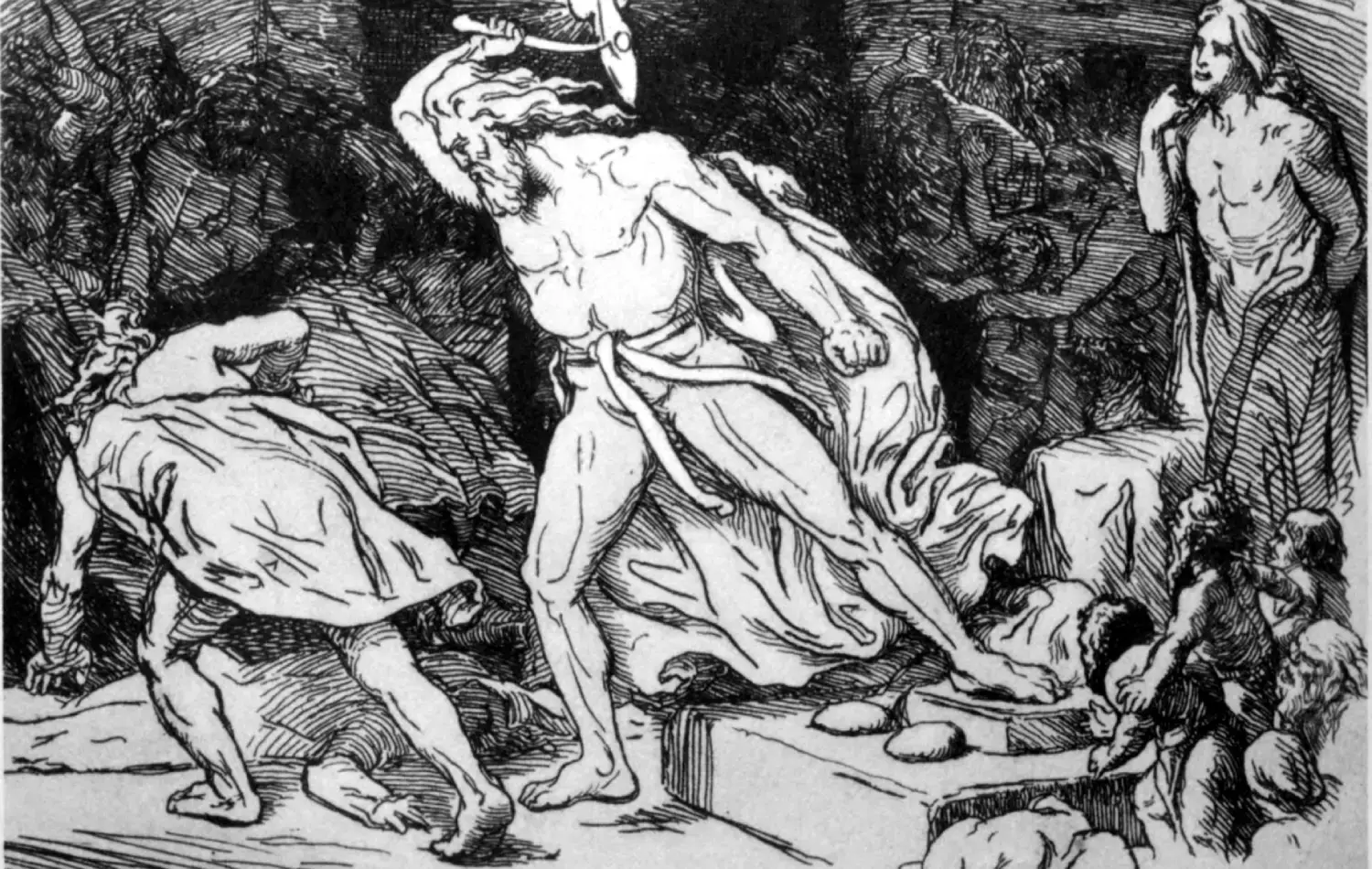
To bless the union, Thrym calls for Mjölnir to be laid in the bride's lap. The moment Thor's hand closes around the shaft, he throws off the veil and slays Thrym and all the wedding guests.
Major Figures in the Story
Thor
The thunder god, forced to swallow his pride and play the blushing bride to recover the weapon that defines him.
Loki
The trickster whose quick tongue keeps the disguise from falling apart, smoothing over every moment Thor nearly gives himself away.
Thrym
The proud king of the giants whose greed for Freyja and for the power of Mjölnir leads to his own destruction.
Freyja & Heimdall
Freyja's flat refusal drives the plot, while Heimdall's unexpected cleverness gives the gods the scheme that wins the day.
Sources and Related Tales
This tale is told in full in the Þrymskviða, one of the most beloved poems of the Poetic Edda. Its blend of high stakes and broad comedy has made it one of the most popular of all the surviving Norse myths.
Thor
The thunder god whose bond with his hammer drives the whole adventure.
Mjölnir
The hammer at the heart of the story, and the shield of the gods against the giants.
Freyja
The goddess whose feather cloak and refused hand set the plan in motion.
Jötunheim
The realm of the giants, where Thor travels in disguise to win back his hammer.
Quick Facts
Key Participants
Thor
The reluctant bride, hiding a warrior's wrath beneath a wedding veil.
Loki
The silver-tongued maidservant who talks the gods out of every near-disaster.
Thrym
The giant king whose greed brings a hall full of giants to ruin.
Themes & Symbolism
Wit over Strength: Thor's raw power is useless without Loki's cunning to get him close to the hammer.
Order and Chaos: Mjölnir is the boundary between the gods and the giants, and its loss threatens the whole cosmic order.
Comedy and Honor: The gods endure humiliation and disguise, yet the tale ends in a decisive triumph.
The Bridal Blessing
Laying a hammer in the bride's lap was a real blessing in old Norse custom, which is exactly why Thrym calls for Mjölnir, and exactly how Thor gets his weapon back.
Freyja's falcon cloak lets its wearer fly between the worlds, a favorite tool of Loki in many of his errands.