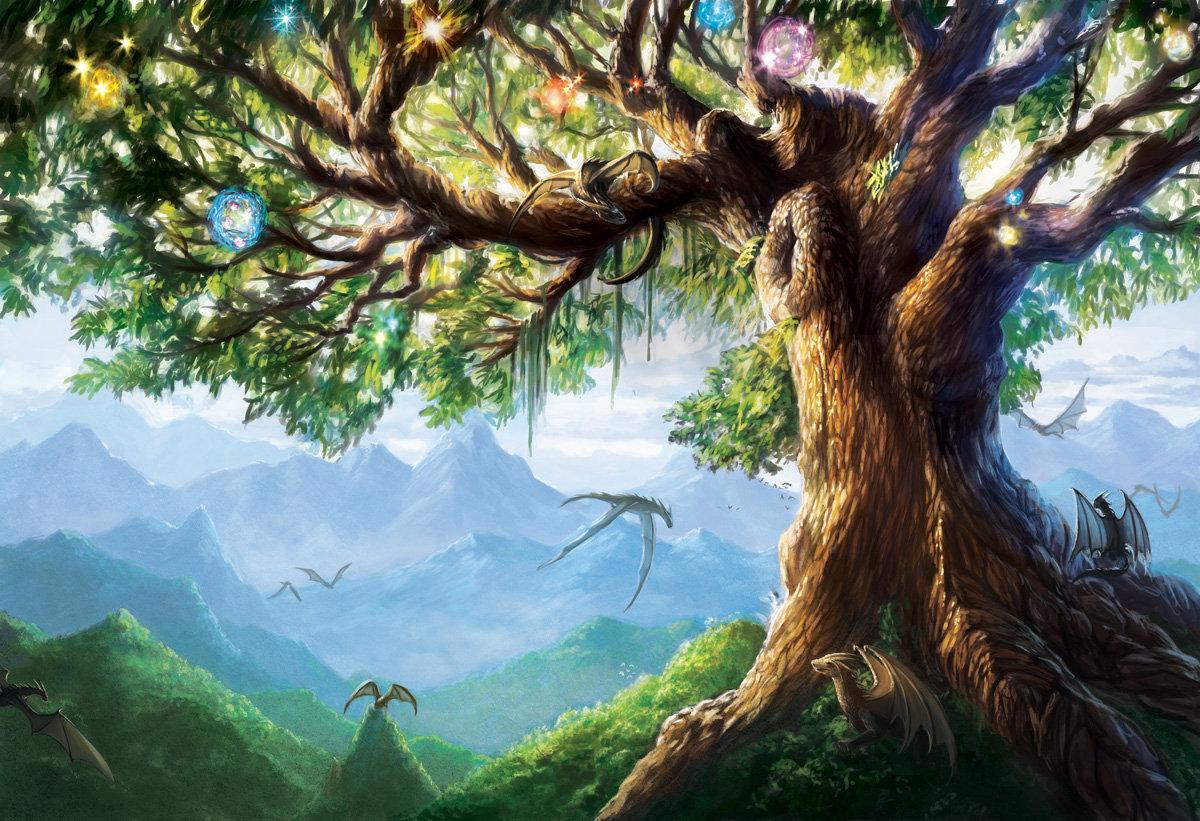
The Nine Worlds and Yggdrasil
The cosmic tree connecting all realms of existence
The Cosmos of the North
Norse mythology encompasses the pre-Christian beliefs and legends of the Scandinavian peoples, including tales of gods, heroes, and supernatural beings. These stories were passed down through oral tradition before being recorded in medieval texts like the Poetic Edda and Prose Edda.
At its heart, Norse mythology presents a cosmos connected by Yggdrasil, the World Tree, with nine realms inhabited by gods, giants, elves, dwarves, and humans. This rich mythology explained natural phenomena, prescribed moral codes, and provided a framework for understanding life and death in the harsh Nordic climate.
The Creation of the World
In the Beginning
In the beginning, there was nothing but a great void called Ginnungagap. To the north lay Niflheim, a realm of ice and cold, while to the south was Muspelheim, a land of fire. When the ice from Niflheim met the sparks from Muspelheim in Ginnungagap, they began to melt and form the first beings.
The First Beings
From these primordial elements came Ymir, the first frost giant, and Audumla, a cosmic cow. As Audumla licked the salty rime-stones, she uncovered Buri, the first god. Buri's son Borr married the giantess Bestla, and they had three sons: Odin, Vili, and Ve—the first Aesir gods.
Creating the World
Odin and his brothers slew Ymir and used his body to create the world. His flesh became the earth, his blood the seas, his bones the mountains, and his skull the sky. They placed the skull over Ginnungagap, held up by four dwarves (Nordri, Sudri, Austri, and Vestri). From Muspelheim's sparks, they created the sun, moon, and stars.
The First Humans
While walking along a beach, Odin, Vili, and Ve found two logs—one ash and one elm. The gods breathed life into these logs, creating the first humans: Ask (from ash) and Embla (from elm). Odin gave them spirit and life, Vili gave them movement and intelligence, and Ve gave them form, speech, feelings, and senses.
Yggdrasil and the Nine Worlds
At the center of the Norse cosmos stands Yggdrasil, an immense ash tree that connects all the nine worlds. Its name means "Ygg's (another name for Odin) horse," referring to when Odin hung himself from the tree for nine days and nights to gain wisdom of the runes.
The Nine Realms
The nine worlds are divided among three levels:
Upper Level:
- Asgard - Home of the Aesir gods, ruled by Odin
- Vanaheim - Realm of the Vanir gods, associated with fertility and wisdom
- Alfheim - World of the Light Elves
Middle Level:
- Midgard - The human world, connected to Asgard by the rainbow bridge Bifrost
- Jotunheim - Land of the giants, enemies of the gods
- Svartalfheim - Realm of the Dark Elves
- Nidavellir - Home of the Dwarves, master craftsmen
Lower Level:
- Muspelheim - Realm of fire, ruled by the fire giant Surtr
- Niflheim - World of ice and mist, containing Hel, the realm of the dead
Guardians of Yggdrasil
At the top of Yggdrasil lives a giant eagle, while at its roots dwells the dragon Nidhug, who gnaws at them. A squirrel named Ratatosk runs up and down the trunk, carrying insults between the eagle and the dragon, keeping their enmity alive.
The Norns
By the Well of Urd at Yggdrasil's roots live the three Norns: Urd (Past), Verdandi (Present), and Skuld (Future). These goddesses of fate spin the threads of destiny for all beings in the cosmos, determining the course of every life.
Cosmic Features
The Sun and Moon
Sol (the Sun) and Máni (the Moon) are siblings who ride chariots across the sky. Sol's chariot is pulled by two horses, Arvakr and Alsvin, while Máni's is drawn by the horse Aldsvider. They are pursued by wolves who seek to devour them.
Day and Night
Nótt (Night) is the daughter of giant Norve. She married three times, with her third husband being Delling of the Aesir. Their son is Dagr (Day), who is as bright as his mother is dark. Both ride through the sky in sequence, with their horses Hrimfaxi and Skinfaxi.
The Divine Pantheon
The Aesir Gods
The Aesir are the principal pantheon of Norse gods who reside in Asgard. They are primarily associated with war, power, and governance.
- Odin
All-Father, god of wisdom, poetry, death, and magic
- Thor
God of thunder, strength, and protection of mankind
- Freya
Goddess of love, beauty, fertility, and war
Other Mythical Beings
Beyond the gods, Norse mythology is populated with a variety of powerful and magical beings.
- Giants (Jötnar)
Primordial beings of immense power, often in conflict with the gods
- Dwarves
Master craftsmen who created many of the gods' magical items
- Elves
Beautiful, magical beings divided into Light and Dark varieties
Ragnarök: The Twilight of the Gods
Norse mythology is unique in having a prophesied end to the cosmos—Ragnarök, the final battle between the gods and their enemies. This apocalyptic event begins after three years of Fimbulwinter, an unending season of ice and snow.
During Ragnarök, cosmic order breaks down: the wolf Fenrir devours Odin, Surtr engulfs the world in flames, and the seas overflow as the Midgard Serpent Jörmungandr rises. Thor slays Jörmungandr but dies from its venom. Heimdall and Loki kill each other, and most gods and giants perish in mutual destruction.
Yet Norse mythology offers hope even in this finality. After the world is consumed by fire and water, a new green earth rises from the sea. Baldr returns from the dead, and a few gods survive. Two humans, Lif and Lifthrasir, who sheltered in Yggdrasil during the destruction, emerge to repopulate the world, beginning the cycle anew.
Read the full prophecy of Ragnarök