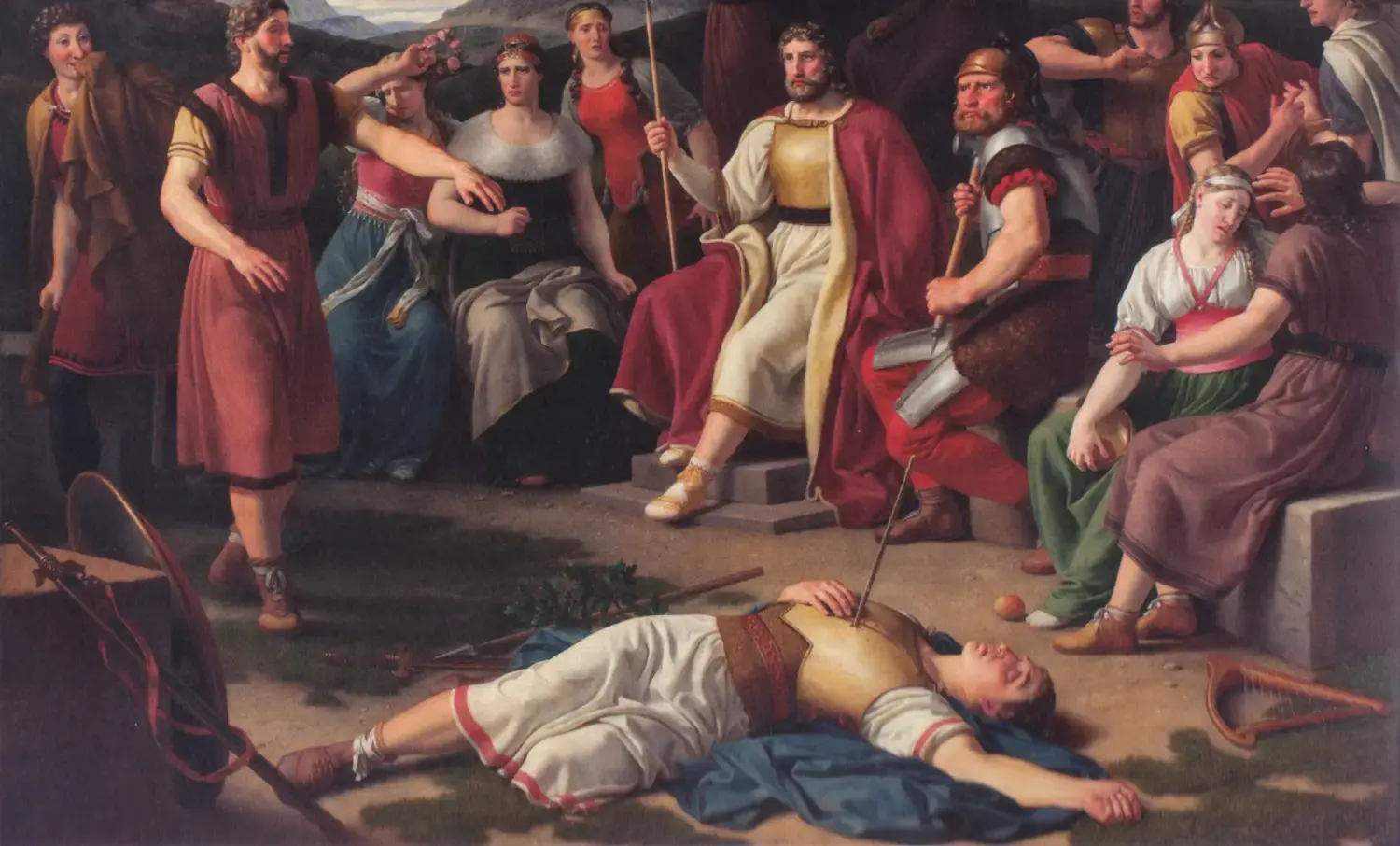
The Fairest of the Gods
Baldr was the beloved son of Odin and Frigg, a god so bright and gracious that light seemed to shine from him. He was gentle, wise, and fair of speech, and the Æsir cherished him above almost all others. When Baldr began to suffer dark dreams foretelling his own death, a shadow fell across Asgard.
To protect her son, Frigg travelled through the nine worlds and drew an oath from every thing that might do him harm. Fire and water, iron and stone, sickness and beasts, trees and serpents all swore never to hurt Baldr. Only one small plant was passed over, thought too young and harmless to matter: the mistletoe.
Believing him invulnerable, the gods made a game of Baldr's safety, hurling weapons and stones at him for sport while everything turned aside. But Loki, ever watchful for weakness, learned the one secret Frigg had left unguarded, and turned the gods' joy into mourning.
Key Events of the Tale
The Ominous Dreams
Baldr is troubled by dreams that foretell his death. The gods gather in council, and Frigg sets out to protect him by binding all things with an oath never to cause him harm.
The Overlooked Mistletoe
Every creature and object swears the oath, but Frigg skips the mistletoe growing west of Valhalla, judging it too small and young to be a threat. Loki, disguised, coaxes this secret from her.
The Blind Archer's Hand
Loki fashions a dart from the mistletoe and seeks out Baldr's blind brother, Höðr, who stands apart from the game. Loki guides his hand, and the dart flies true, piercing Baldr, who falls dead upon the ground.
The Ride to Hel
The gods are stricken with grief. Hermóðr, another son of Odin, borrows Sleipnir and rides nine nights down the dark roads to Hel to plead for Baldr's release from the realm of the dead.
The One Who Would Not Weep
Hel agrees to free Baldr only if every living and dead thing weeps for him. All the world mourns, save a single giantess named Þökk, widely believed to be Loki in disguise, whose refusal condemns Baldr to remain among the dead.
Major Figures in the Story
Baldr
The radiant god of light and goodness whose death marks the first great sorrow of the Æsir and the beginning of the end of the old world.
Höðr
Baldr's blind brother, an unwitting instrument of the killing. He casts the fatal dart without malice, deceived by Loki's guiding hand.
Loki
The trickster who engineers Baldr's death and later blocks his return. This act finally exhausts the patience of the gods and leads to Loki's binding.
Frigg & Hermóðr
Frigg's love drives the oath that almost saves her son, while Hermóðr's brave ride to Hel is the gods' last hope of winning Baldr back from death.
The Funeral at Sea
Baldr was laid upon his great ship, Hringhorni, for a funeral worthy of a god. His wife Nanna died of grief and was placed beside him on the pyre. The ship was so heavy that the gods could not launch it, and they called upon the giantess Hyrrokkin, who pushed it into the sea with a single mighty shove. Thor hallowed the pyre with his hammer Mjölnir, and Odin laid the ring Draupnir upon his son before the flames rose over the water.
Sources and Related Tales
The fullest account of Baldr's death comes from the Prose Edda of Snorri Sturluson, in the section known as Gylfaginning. The Poetic Edda also touches on it in Völuspá and Baldrs draumar, where Odin rides to question a dead seeress about his son's fate.
Ragnarök
Baldr's death is the first sign of the doom of the gods, and he returns to the renewed world after the final battle.
Loki
The trickster whose treachery here turns the gods against him for the last time.
Odin
The grieving father who seeks knowledge of Baldr's fate and lays Draupnir on his funeral pyre.
Helheim
The shadowy realm of the dead where Baldr must remain until the world is reborn.
Quick Facts
Key Participants
Baldr & Nanna
The shining god and his devoted wife, who dies of grief and joins him on the funeral pyre.
Höðr & Loki
The blind brother who throws the dart and the trickster who guides his hand.
Frigg & Hermóðr
The mother who binds the world with oaths and the son who rides to Hel to bargain for Baldr.
Symbols in the Tale
The Mistletoe
A humble plant that becomes the one weapon able to kill the unkillable god.
Hringhorni
Baldr's vast ship, set ablaze as his funeral pyre upon the sea.
The Tears of the World
All things weep for Baldr except one, a refusal that seals his fate.
Themes & Symbolism
Fragile Perfection: Even a god guarded by the oaths of all creation can fall to the one thing left unwatched.
Grief and Loss: Baldr's death brings the first true sorrow to the gods and foreshadows their own end.
Death and Return: Though bound to Hel, Baldr is promised a return to the green world reborn after Ragnarök.