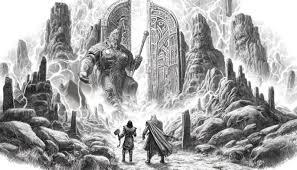
A Journey into the Realm of Illusions
Thor's Journey to Útgarðr is one of the most famous and surprising stories in Norse mythology. It tells how Thor, Loki, and Thor's human companions Þjálfi and Röskva travel into Jötunheim and visit the fortress of Útgarðr, ruled by the giant Útgarða-Loki. There, the thunder god faces a series of humiliating trials that appear to prove his weakness.
The tale, preserved in the Prose Edda, reveals that nothing in Útgarðr is as it seems. Thor's failures are not due to lack of strength, but because he is unknowingly competing against cosmic forces disguised by illusion and magic. The story shows that even the mightiest god can be deceived and that true power is not always obvious at first glance.
This journey highlights themes of pride, trickery, and the vast gulf between the world of gods and the deeper powers of the cosmos. It also underscores Thor's relentless determination, even when the odds are stacked against him.
Key Events of the Journey
Setting Out from Asgard
Thor and Loki travel with two human children, Þjálfi and Röskva, whom Thor has taken into his service. Their path leads toward Jötunheim, the land of the giants, where Thor intends to prove his strength and confront his ancient foes.
Meeting Skrýmir the Giant
The travelers meet a huge giant named Skrýmir, who offers to carry their food bag. At night, Thor repeatedly strikes the sleeping giant with Mjölnir, but Skrýmir wakes only to remark that acorns or leaves have fallen on his head, seemingly unharmed by Thor's blows.
Arrival at Útgarðr
The group reaches Útgarðr, a great fortress in Jötunheim. Útgarða-Loki, its ruler, welcomes them but mocks their reputations. He declares that none may stay unless they demonstrate skill or strength in contests of his choosing.
The Contests and Apparent Defeats
Loki loses an eating contest to a giant named Logi. Þjálfi loses a race against a runner called Hugi. Thor fails to drain a drinking horn, cannot lift a grey cat from the floor, and is brought to one knee by an old woman named Elli in a wrestling match. The gods seem utterly outclassed by the giants of Útgarðr.
The Reveal of the Illusions
After escorting them out of Útgarðr, Útgarða-Loki reveals the truth: Skrýmir and Útgarða-Loki were the same giant, and every contest was an illusion. Loki competed against wildfire itself, Þjálfi against thought, Thor's horn was connected to the ocean, the cat was the Midgard Serpent, and Elli was Old Age. Thor's efforts nearly emptied the sea, disturbed the serpent, and proved terrifyingly strong.
Major Figures in the Tale
Thor
The thunder god, famed for his strength and quick temper. In Útgarðr he appears to fail his trials, yet the illusions reveal that his power is so great that giants fear him even when he seems defeated.
Loki
The trickster god accompanies Thor and competes in the eating contest. His defeat by Logi foreshadows the deeper magic and elemental forces at work in Útgarðr.
Útgarða-Loki / Skrýmir
The giant king of Útgarðr who uses illusions to test the gods. His magic reshapes reality, making Thor's struggles appear small while actually measuring him against cosmic forces.
Þjálfi and Röskva
Human siblings who serve Thor. Þjálfi's failed race against Hugi demonstrates the limits of mortal speed when matched against pure thought, while Röskva plays a quieter role as witness to the journey.
Sources and Related Tales
The story of Thor's Journey to Útgarðr is told in the Prose Edda, especially in the section Gylfaginning, where King Gylfi hears myths of the gods. It offers one of the most detailed and playful portraits of Thor and Loki interacting with the giants of Jötunheim.
Thor
Explore Thor's other adventures, his weapons, and his role as defender of gods and humans.
Loki
Learn more about the trickster whose schemes shape many Norse myths.
Jötunheim
The wild land of the giants, where Útgarðr stands as a fortress of magic and challenge.
Ragnarök
The final battle in which Thor again faces the limits of his strength against cosmic forces.
Quick Facts
Key Participants
Thor
Tests his strength against illusions and learns that even he can be outplayed by magic.
Loki
Serves as companion and participant, losing his own contest to the embodiment of wildfire.
Útgarða-Loki
The giant king whose illusions reveal, rather than diminish, the terrifying scope of Thor's power.
Illusions & Tests
Horn of the Sea: Thor's drinking horn was linked to the ocean itself, so each gulp literally lowered the sea level.
The Grey Cat: The cat Thor tried to lift was the Midgard Serpent in disguise, coiled around the world.
Old Age: The old woman Elli represented Old Age, a force no one can defeat forever, not even Thor.
Themes & Symbolism
Humility and Pride: Thor's apparent defeats challenge his pride and show that even the strongest can be misled.
Illusion vs. Reality: The tale warns that appearances can be deceiving, and that true power may be hidden beneath clever tricks.
Cosmic Scale: By pitting Thor against thought, time, and the sea, the story places him within a larger, awe-inspiring cosmos.