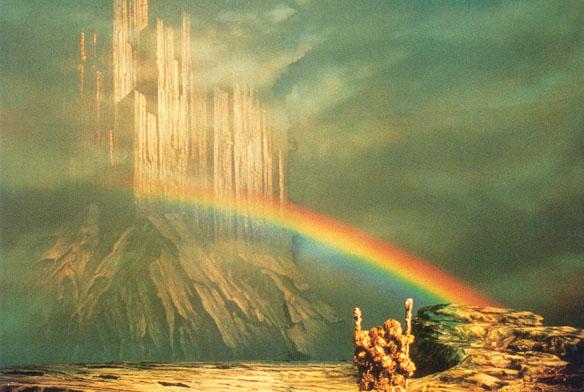
A Bargain the Gods Regretted
After the wars of the gods, the wall that once guarded Asgard lay broken. A lone builder arrived and offered to raise a new wall so strong that no giant could ever breach it. In return he asked for the goddess Freyja, along with the sun and the moon.
The price was outrageous, but Loki urged the gods to accept on one condition: the builder must finish in a single winter, with no help from any man. The builder agreed to the terms, asking only that he be allowed the aid of his stallion, Svaðilfari. Against their better judgment, and on Loki's advice, the gods consented.
To their alarm, the stallion proved as strong as the builder himself, hauling stones larger than any horse should manage. As winter drew to a close, the wall stood almost complete, and the gods faced the ruin of losing Freyja and the very lights of the sky.
Key Events of the Tale
The Builder's Offer
A stranger offers to rebuild Asgard's wall in three seasons. Loki convinces the gods to shorten the deadline to one winter, certain the task cannot be done in time.
The Tireless Stallion
By night the horse Svaðilfari drags colossal stones from the mountains, doing more work than the builder himself. The wall rises far faster than the gods believed possible.
The Gods Turn on Loki
With only days left and the wall nearly finished, the gods realize their peril. They round on Loki, whose counsel led them here, and threaten him with death unless he undoes the bargain.
Loki and the Mare
That night Loki takes the shape of a beautiful mare and lures Svaðilfari away into the woods. Without his stallion, the builder cannot finish the wall, and the deadline slips past.
The Builder Revealed
Cheated of his prize, the builder flies into a rage that betrays his true nature as a giant. The oaths of protection no longer bind the gods, and Thor shatters his skull with Mjölnir.
The Birth of Sleipnir
Loki's ruse had a lasting consequence. Some time later he returned to Asgard and bore a foal, grey and eight-legged, sired by Svaðilfari during that night in the woods. This was Sleipnir, the swiftest of all horses, who could gallop over land, sea, and sky. Loki gave the steed to Odin, and Sleipnir carried the All Father on many of his greatest journeys, including the ride to Hel itself.
Sources and Related Tales
The story is told by Snorri Sturluson in the Prose Edda, in the section called Gylfaginning, and is hinted at in the Poetic Edda poem Völuspá, which speaks of the broken oaths of the gods.
Sleipnir
Odin's eight-legged steed, born of Loki and the stallion Svaðilfari.
Loki
The shape-shifter whose scheme both causes the crisis and resolves it.
Asgard
The home of the gods, whose great defensive wall is the prize of this tale.
Freyja
The goddess the builder demands as payment, along with the sun and moon.
Quick Facts
Key Participants
The Master Builder
A giant in disguise who almost wins the sun, the moon, and a goddess.
Loki
Author of the bargain and, as a mare, the one who breaks it.
Svaðilfari & Sleipnir
The mighty stallion and the eight-legged foal born of the night chase.
What Was at Stake
Freyja
The goddess of love, demanded as the builder's bride.
The Sun & Moon
The lights of the sky, without which the worlds would fall into darkness.
The Wall
The defense the gods gained even after refusing to pay for it.
Themes & Symbolism
Oaths and Loopholes: The gods keep the letter of the deal while escaping its cost, a recurring theme in Norse myth.
The Cost of Trickery: Loki saves the gods, but only by paying a strange and personal price.
Chaos as Creator: From a reckless bargain comes Sleipnir, one of the great treasures of the gods.