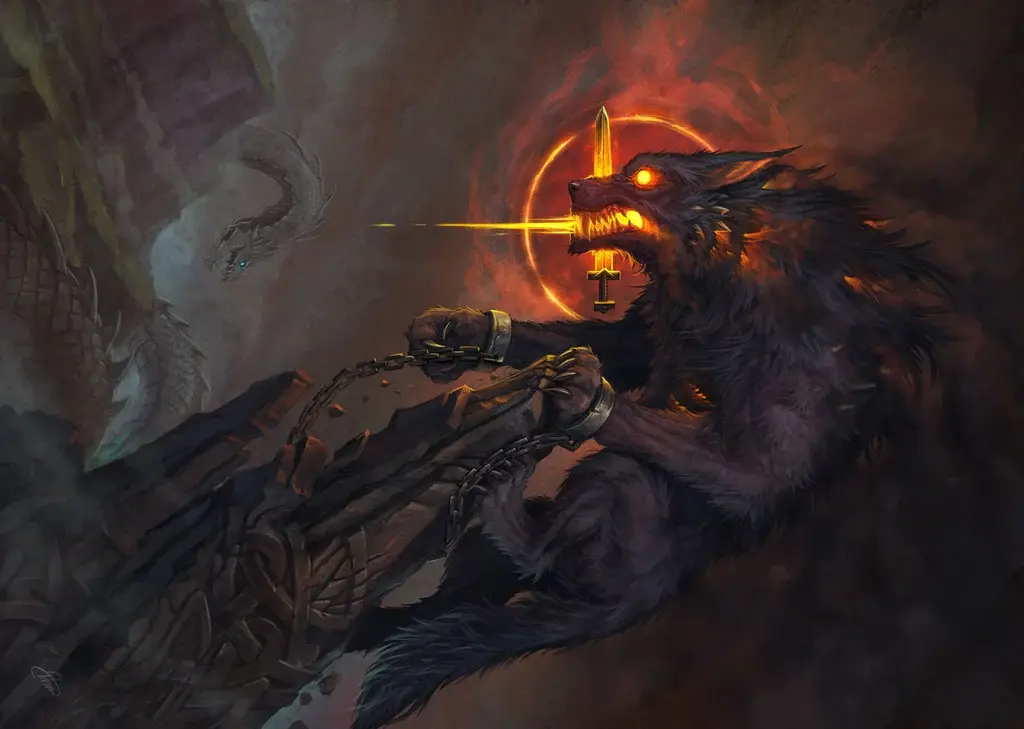
The Wolf Who Frightened the Gods
The Binding of Fenrir is one of the most dramatic episodes in Norse mythology. It tells how the gods of Asgard, terrified by prophecy, decide to imprison the giant wolf Fenrir, child of Loki and the giantess Angrboða. Fenrir is fated to break free at Ragnarök and devour Odin himself.
While young, Fenrir is raised among the gods in Asgard, growing ever larger and more fearsome. Only the god Týr is brave enough to feed him. When the gods realize that ordinary weapons and restraints cannot contain the wolf, they resort to trickery and a magical fetter forged by dwarves.
The story explores fear, fate, and the cost of trying to control something destined to bring about one's doom. It also explains why Týr has only one hand and sets the stage for the events of Ragnarök.
Key Events of the Binding
Fenrir Raised in Asgard
Fearing his potential, yet unwilling at first to kill him, the Æsir keep Fenrir in Asgard. The wolf grows at an unnatural rate, and soon only Týr has the courage to approach and feed him.
The First Two Chains: Lœðing and Drómi
The gods forge two massive iron chains, Lœðing and Drómi, and challenge Fenrir to test his strength by breaking them. The wolf easily snaps both, proving that no ordinary binding can hold him.
Gleipnir: The Impossible Fetter
The Æsir send for the dwarves of Svartálfaheimr, who craft the magical ribbon Gleipnir from impossible ingredients: the sound of a cat's footfall, a woman's beard, mountain roots, bear's sinews, fish's breath, and bird's spittle. Although thin and smooth, it is stronger than any chain.
Týr's Sacrifice
Sensing trickery, Fenrir demands that one god place a hand in his mouth as a pledge of good faith. Only Týr agrees. When Fenrir finds he cannot break Gleipnir, he bites off Týr's hand, and the gods, having broken their oath, leave the wolf bound.
Fenrir's Imprisonment and Prophecy
The gods fasten Gleipnir to a great stone and drive a sword into Fenrir's jaws to hold them open. Foam and blood form the river Ván around him. He remains chained until Ragnarök, when he will finally break free and confront Odin.
Major Figures in the Tale
Fenrir
The monstrous wolf whose strength and destined role in Ragnarök terrify the gods. His binding shows both the gods' power and their fear of fate.
Týr
The god of law, oaths, and battle. Týr's willingness to risk his hand for the safety of gods and worlds makes him one of the most tragic and honorable figures in the myth.
Odin and the Æsir
Odin and the other gods choose deception and binding over open battle, believing it is the only way to postpone the doom prophesied at Ragnarök.
The Dwarven Smiths
Master craftsmen of the underworld, the dwarves forge Gleipnir, showing how magic and craft can do what brute force cannot.
Sources and Related Tales
The Binding of Fenrir is primarily preserved in the Prose Edda of Snorri Sturluson, especially in the section Gylfaginning. Elements of the story also echo themes found in the Poetic Edda, where Fenrir's role at Ragnarök is described.
Ragnarök
The prophesied end of the world, in which Fenrir breaks his bonds and fulfils his destiny.
Fenrir
A deeper look at the origins, family, and symbolism of the great wolf.
Týr
Learn more about the one-handed god of law, war, and sacrifice.
Loki's Children
The tales of Fenrir, Jörmungandr, and Hel, and how the gods tried to control them.
Quick Facts
Key Participants
Fenrir
The wolf whose strength and fate drive the gods to desperate measures.
Týr
The only god willing to place his hand in Fenrir's jaws to secure the binding.
The Æsir & Dwarves
Odin and the Æsir who plan the binding, and the dwarves whose craft makes Gleipnir possible.
Symbols & Motifs
Chains and Oaths: The story links physical bonds (Gleipnir) with broken promises, showing how control often comes at a moral cost.
Fear of Fate: The gods act out of fear of prophecy, yet their actions help fulfil the very future they wish to avoid.
Sacrifice and Justice: Týr's lost hand symbolizes the personal price of enforcing order in a dangerous world.
Link to Ragnarök
Although the binding seems like a victory for the gods, it is only a delay. Fenrir's rage and humiliation add fuel to the coming catastrophe of Ragnarök.
Read about Ragnarök →